
Course Description
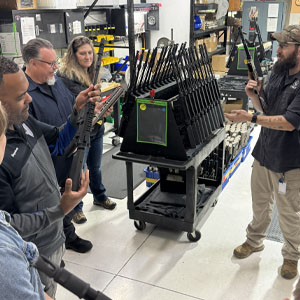
This course is designed to provide instruction and on-site manufacturing tours at major ammunition and firearms producers (examples: Winchester, Remington, Troy Industries, Barrett, Smith & Wesson, Glock, G2 Research, Heckler & Koch, Steyr Arms). The course is designed for forensic firearms examiners, trainees, and advanced students in forensic sciences. Through guided facility tours, students may observe real-world production processes - metalworking, machining, barrel forging, rifling, case and projectile manufacturing, plastic injection molding, coatings, heat treatment, and assembly - that can create class, subclass, or carryover features. Emphasis is placed on how manufacturing processes generate surface patterns and characteristics that may be viewed microscopically in toolmark comparisons. Students will learn to recognize, document, and account for manufacturing-derived characteristics.
Course Objectives
Upon successful completion of this course, a student should be able to:
- Identify major ammunition and firearm manufacturing processes (e.g., forging, CNC machining, EDM/ECM, button/broach rifling, hammer forging, plastic injection molding, stamping, heat treatment, barrel straightening, surface finishing/coating) and describe how each process produces characteristic surface features, if any.
- Differentiate between class/subclass manufacturing marks and true individual toolmarks as previously viewed on firearms and ammunition components.
- Explain how production-level variables (tool wear, tool/die design, production tolerances, batch tooling, secondary finishing) can create carryover patterns and consistent subclass characteristics across multiple components.
- Recognize manufacturing-related markings and surface patterns as viewed on firearms and ammunition components.
- Analyze sample fired evidence against manufacturing samples to determine whether observed features are attributable to manufacturing processes, post-manufacture tool use, or individualizing toolmarks.
- Evaluate the potential impact of coatings (cerakote), plating, and polymer components (e.g., injection-molded frames/slides) on evidence recovered items, comparison results, and microscopic interpretation of marks.

Course Logistics
Course Expectations
The Ammunition and Firearm Manufacturing Tours course is an active learning experience requiring participation in onsite facility tours, lectures, and guided discussions. Each student/attendee is expected to maintain detailed manufacturing notes throughout the course; these notes may be reviewed or referenced during both onsite activities and subsequent remote discussions.
This course emphasizes a practical, process-oriented understanding of the machining and manufacturing methods used to produce ammunition and firearm components. Instruction will focus on how these processes generate toolmarks, providing attendees with foundational knowledge applicable to forensic examination and testimony—particularly in addressing admissibility and methodology-based inquiries.
Students/attendees are expected to come prepared, having reviewed all recommended readings and handout materials prior to participating in scheduled tours.