
Course Description
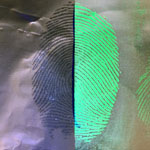
This course is designed to introduce the students to physical latent print development techniques through practical exercises, lectures, and discussions. An understanding of inherent florescence, adhesive processing, wet item processing, and powder processing techniques are included as well as laboratory safety, handling of evidence, and hands on workshops that teach the student how to properly and safely develop latent prints. Students will have the opportunity to work in groups processing items that they might encounter in the field. This information will help the student decipher which processing methods to use on a given surface, and how to capture the most fingerprint evidence while performing said processes.
Course Objectives
At the completion of this course, the students should be able to:
- Understand the Anatomy of friction ridge skin and the roll glands, secretions, and residue play in leaving a print
- Understand the differences between a latent print, a patent print, and a plastic print
- Understand the different types of friction ridge residue or matrix and how this effects latent print development
- Understand the differences in surface types, or substrates, and how this effects latent print development and collection
- Understand how to navigate collection of latent prints on unusual or oddly shaped surfaces
- Understand the function of physical evidence
- Understand the importance of proper evidence handling and laboratory safety
- Understand the environmental factors and how these can affect the collection of latent prints
- Understand how to avoid loss, destruction or contamination of evidence
- Understand the different types of physical processing techniques or development mediums
- Understand why sequential processing is important
- Understand basic powder processing techniques
- Different types of brushes
- Different types of lifting materials and preservation
- Different types of backing materials
- Different types of powders
- Understand the proper method for documentation on lifts
- Understand how the challenges involved in removing adhesive evidence and how to process it once it has been removed
- Understand when and how to process a non-porous item of evidence that has been wet
- Understand the proper method for casting fingerprints usings Accutrans and Mikrosil
- Understand the difficulties involved in arson cases and how to collect fingerprints from them

Course Logistics
March 15, 2027 - March 19, 2027
8:00 AM to 5:00 PM
RSA Forensics Latent Print Academy
1524 MS-19
Meridian, MS 39307
40
$1,000.00
Local Contact
RSA Forensics
Matt Marvin, Academy Director
601-626-1100
info@rsaforensics.com
Course Schedule
| Duration | Day 1 | Day 2 | Day 3 | Day 4 | Day 5 |
|---|---|---|---|---|---|
| 1 Hour | Instructor Introduction and Class Expectations | Laboratory Safety | Comparison Exercise | Practical processing in the laboratory | Comparison Exercise |
| 1 Hour | Physical latent print processing | Practical Exam | |||
| 1 Hour | Processing adhesive evidence | ||||
| 1 Hour | |||||
| 1 Hour | Lunch | Lunch | Lunch | Lunch | Lunch |
| 1 Hour | Physical latent print processing | Physical processing of wet evidence | Practical processing in the laboratory | Comparison Exercise | Practical Exam |
| 1 Hour | |||||
| 1 Hour | Arson scenes and how to process them | Written Exam | |||
| 1 Hour | Review and questions |
Recommended Reading
- Scott’s Fingerprint Mechanics, Olsen, R.D. (1978), pp. 111-139, 161-199, 209-235, 243-255 and 369- 395.
- Basic Latent Print Development, Mock, James P. (1993) pp 1-41.
- The Fingerprint Sourcebook, National Institute of Justice, Sections 7.1, 7.2, 7.3, 7.9 and 7.10.
- Processing Guide for Developing Latent Prints, United States Department of Justice, pp. 1-13, 18, 26-31
- Quantitative-Qualitative Friction Ridge Analysis: An Introduction to Basic and Advanced Ridgeology, Ashbaugh, D. (1999), pp. 120-122.
- The Science of Fingerprints, Federal Bureau of Investigation (1984), pp. 173-177.
- Fingerprint Development Handbook, Police Scientific Development Branch Home Office, (2000) pp.2- 45, 63-64, 75-82, 93-94 and 97-99.
- Fingerprint Detection Techniques, Margot, Pierre, Lennard, Chris, (1994) pp. 28-53, 59-69.
- Friction Ridge Skin, Cowger, James F., (1983) Chapter 4.
- Fingerprints and Other Ridge Skin Impressions, Champod, C., Lennard, C., Margot, P., and Stoilovic, M., (2004), Chapter 4.1-4.3, 4.5 and 4.6.1.
- Advances in Fingerprint Technology, Lee, H.C., Gaensslen, R.E., (2013) 3rd ed., Chapters 1, 5, 8, & 11. Fingerprints and Other Ridge Skin Impressions 2 nd Edition, Champod, C., Lennard, C., Margot, P., and Stoilovic, M., (2004), Chapter 4, Pages 216 through 219.
Helpful Lodging Information
Although we cannot endorse any particular hotel property, we have confirmed that the following lodging options are within a reasonable commuting distance to the training site.
Drury Inn & Suites Meridian
112 US-11
Meridian MS 39301