
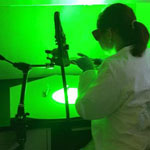
Course Description
This course is intended to teach students how various types of evidence are chemically processed in order to develop latent print impressions present on the surface. There will be a review the various categories of substrate types based on characteristics of each, a review of how chemical processing differs from physical latent print processing methods, what sequential processing is, and how it is utilized within forensic laboratories to develop latent prints of different surface types. The course will also cover the most commonly used chemical processing methods and equipment and will instruct the students on proper laboratory safety procedures, how chemicals can be mixed and prepared, and the various methods for applying latent print development chemicals to evidence. Students will participate in a number of hands-on exercises intended to help them learn how various methods of chemical processing are implemented on different surface types including porous, non-porous, and semi-porous.
Course Objectives
At the completion of this course, the students should be able to:
- Understand the different substrate types including porous, non-porous, and semi-porous, as well as the characteristics and properties of each
- Understand the different types of matrices, and how they are targeted using chemical developers
- Understand what sequential processing procedures are, why they are utilized, and how they can be implemented to processing various evidence types within a laboratory system
- Understand when and why to deviate from standard sequential processing procedures in some circumstances
- Understand proper laboratory safety procedures
- Understand how various stock and working solutions should be safely prepared prior to use
- Understand the most used latent print development chemicals, how they are used, the methods of application, the expected reaction, and the conditions or equipment needed to facilitate development
- Understand how each technique can be visualized post-development
Course Logistics
March 22, 2027 - March 26, 2027
8:00 AM to 5:00 PM
RSA Forensics Latent Print Academy
1524 MS-19
Meridian, MS 39307
40
$1,000.00
Local Contact
RSA Forensics
Matt Marvin, Academy Director
601-626-1100
info@rsaforensics.com
Course Schedule
| Duration | Day 1 | Day 2 | Day 3 | Day 4 | Day 5 |
|---|---|---|---|---|---|
| 1 Hour | Course introduction / expectations | Lab rotations / practical processing exercises (instructor monitored and led using lab manual) * | Lab rotations / practical processing exercises (instructor monitored and led using lab manual) * | Lab rotations / practical processing exercises (instructor monitored and led using lab manual) * | Lab processing review and test review |
| 1 Hour | Lecture: Substrates and matrix | Self-guided study / comparison exercises | |||
| 1 Hour | Lecture: Sequential processing | ||||
| 1 Hour | Lecture: Mixing chemicals / preparing working solutions | ||||
| 1 Hour | Lunch | Lunch | Lunch | Lunch | Lunch |
| 1 Hour | Lecture: Chemical processing (review of commonly used chemical processes) | Lab rotations / practical processing exercises (instructor monitored and led using lab manual) * | Lab rotations / practical processing exercises (instructor monitored and led using lab manual) * | Lab rotations / practical processing exercises (instructor monitored and led using lab manual) * | Written exam |
| 1 Hour | |||||
| 1 Hour | Post-exam review | ||||
| 1 Hour | Lab safety brief | Closing and final course review |
Recommended Reading
- The Fingerprint Sourcebook, National Institute of Justice, 7.4-7.8, 7.10-7.12, 7.13.4.
- The Science of Fingerprints, Federal Bureau of Investigation (1984), Chapter 15.
- Scott’s Fingerprint Mechanics, Olsen, R.D. (1978), pp. 111-139, 161-199, 209-235, 243-255 and 369-395.
- Fingerprint Detection with LASERS, Menzel, E. Roland (2nd Ed.)
- Processing Guide for Developing Latent Prints, United States Department of Justice, pp. 1-4, 14-18, 21-26, 31-64.
- Fingerprint Detection by Fluorescence Examination: A Guide to Operational Implementation, Police Scientific Development Branch, Science and Technology Group Home Office (2nd Ed.) 1992.
- Safety for the Forensic Identification Specialist, Masters, Nancy E., (2nd Ed.) 2002.
- Fingerprint Development Handbook, Police Scientific Development Branch Home Office, (2000) pp. 48-62, 65-74, 83-92 and 95-96.
- Fingerprint Detection Techniques, Margot, Pierre, Lennard, Chris, (1994) pp. 56-58, 70-130 -Fingerprints and Other Ridge Skin Impressions, Champod, C., Lennard, C., Margot, P., and Stoilovic, M., (2004), Chapter 3.1-3.4, 4.
- Advances in Fingerprint Technology, Lee, H.C., Gaensslen, R.E., (2013) 3rd ed., Chapters 2-4, 6, 7, 9, 10, 12, & 13.
- Fingerprints and Other Ridge Skin Impressions, 2nd Edition, Champod, C., Lennard, C., Margot, P., and Stoilovic, M., (2004), Chapter 4 pages 179-214, 221-293.
Helpful Lodging Information
Although we cannot endorse any particular hotel property, we have confirmed that the following lodging options are within a reasonable commuting distance to the training site.
Drury Inn & Suites Meridian
112 US-11
Meridian MS 39301