
Course Description
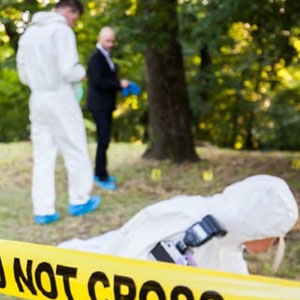
Expectations of the public and the courts have risen dramatically over the last several years in the area of physical evidence collection and forensic identification. Additionally, there is a need for “Homeland Security” protection through awareness, collection, and identification of physical evidence at the local level. Working a crime scene is a “process” that involves a broad range of Skills. With these issues in mind, the purpose of this course is to train crime scene personnel in the skills needed to identify, photograph, process, and preserve the crime scene and items of evidence found in it. The course is intended to provide a foundation for the future development of such expertise through experience and continued training.
Target Audience
This five-day crime scene course provides instruction in the identification, processing, preservation, and recovery of physical evidence, including: scene responsibilities, crime lab capabilities, scene equipment, scene and evidence photography, searching & measuring, biological & trace evidence, footwear & tire evidence, fingerprint processing, and handwriting evidence. Expectations of the public and the courts have risen dramatically over the last several years in the area of physical evidence collection and forensic identification. Working a crime scene is a “process” that involves a broad range of skills. With these issues in mind, the purpose of this course is to train crime scene personnel in the skills needed to identify, photograph, process, and preserve the crime scene and items of evidence found in it. The course is intended to provide a foundation for the future development of such expertise through experience and continued training. Attendees will receive lectures and demonstrations, participate in class discussions, and perform practical exercises to demonstrate acquired skills.
Course Logistics
April 27, 2026 - May 1, 2026
Knowles Hall, Conference Center - Potsdam
SUNY Potsdam
44 Pierrepont Ave.; Barrington Drive
Potsdam, NY 13676
40
$650.00
Local Contact
St. Lawrence County Sheriff's Office
Shawn McCargar, Undersheriff
315-379-2365
smccargar@stlawco.gov
Course Schedule
| Duration | Day 1 | Day 2 | Day 3 | Day 4 | Day 5 |
|---|---|---|---|---|---|
| 1 Hour | Welcome / Introduction / Course Overview | Photography - Sensors / Lens Functions / Digital Media | Photography - Time Exposure / Painting with Light / Composure / Anatomy / Injury | Footwear Cast Evaluations / Searching & Sketching | Physiology of Friction Skin |
| 1 Hour | |||||
| 1 Hour | Equipment & Physical Evidence | Photography - Image Quality and Size / Exposure Compensation / Shutter Speed | Photography - Composure / Accidents / Injuries / Archiving Images | Biological Evidence | |
| 1 Hour | Crime Scene Investigation / Responsibilities | Textured / Difficult Surfaces | |||
| 1 Hour | Lunch | Lunch | Lunch | Lunch | Lunch |
| 1 Hour | Crime Lab Capabilities | Photography - Aperture / ISO Settings / Light Meter Usage | Footwear & Tire Track Impressions Discovery, Collection, Lifting, and Casting | Trace Evidence - Hair and Fibers / Firearms and Ammunition / Glass / Paints / GSR / Building Materials / Tool Impressions / Arson | Fingerprints - Chemical Processing |
| 1 Hour | Introduction to Crime Scene Photography | ||||
| 1 Hour | Photography - Camera Controls and Basic Mechanics | Photography -Histograms / Shooting Data / White Balance / Intro to Flash | Footwear Evidence Continued | Death Scenes / Fingerprint Evidence Fabrication / Handwriting Evidence | |
| 1 Hour | Introduction to Fingerprints - History & Usage |
Must Bring to Class
Students should wear appropriate business-casual clothing for practical exercises conducted both indoors and outdoors. Clothing can become soiled or ruined during practical exercises due to chemicals and/or exposure to the elements.
Students are asked to bring the following:
- Digital camera (digital SLR preferred) and instruction manual.
- Lens
- Batteries for the camera and flash
- Digital media
- Off-camera flash and instruction manual
- Remote flash cord
- Tripod (if available)
- A flashlight
- A basic latent processing kit
These items are not required to attend class, but students are strongly encouraged to bring them to enhance their learning experience.
Course Objectives
- Describe the evidence technician's crime scene responsibilities.
- Identify various types of physical evidence and crime lab capabilities.
- Explain and demonstrate methods used to search and measure crime scenes.
- Describe and explain proper scene and evidence photography.
- Demonstrate various camera settings changes to achieve proper exposure.
- Identify types of trace evidence and describe proper collection methods.
- Demonstrate processing and recovery methods for two and three-dimensional footwear and tire evidence.
- Demonstrate techniques for fingerprint evidence processing and recovery.
Training Certification and Recertification Credits
Fundamentals of Crime Scene Examination and Evidence Collection may qualify for specific continuing education training credits. Use's summary below as a quick reference for organization and discipline specific applicability. The approving organization has final authority and their website should be referenced before submitting any request for training credits.
International Association for Identification (I.A.I.) Crime Scene Certification Board Approved for 40 Certification Credits
International Association for Identification (I.A.I.) Crime Scene Certification Board Approved for 40 Re-Certification Credits
Helpful Lodging Information
Although we cannot endorse any particular hotel property, we have confirmed that the following lodging options are within a reasonable commuting distance to the training site.
Best Western University Park Inn - Potsdam
One Main St.
Potsdam NY 13676
315-265-3050
Hampton Inn Potsdam
169 Market St.
Potsdam NY 13676
(315) 265-0100